
Design for Manufacture and Assembly promises significant schedule reductions — independent studies and contractor post-project analyses consistently cite 20–40% program savings on projects where DfMA principles are applied from inception. The most frequently referenced benchmarks come from the UK’s Manufacturing Technology Centre (MTC) and McKinsey’s 2019 global construction productivity report, both of which place schedule savings in the 20–35% range for well-executed modular programs. The 30–40% figure circulates widely in vendor materials; treat it as an upper bound achieved under optimal conditions, not a baseline expectation.
In practice, most projects abandon DfMA principles by week three of design development — not because the concept fails, but because the handoff between architect and manufacturer happens too late.
Where It Goes Wrong: The Late Engagement Problem
The projects that struggle are overwhelmingly private commercial developments and mixed-use residential schemes where the procurement sequence follows conventional logic: design first, procure later. Public sector projects — particularly social housing programs in the UK, Singapore, and Scandinavia — have a better track record precisely because framework agreements often mandate manufacturer engagement earlier in the process.
The fundamental error is treating DfMA as a procurement decision rather than a design constraint. By the time a modular manufacturer is engaged, structural grids are fixed, MEP coordination is done, and connection details are already baked into permit drawings. The manufacturer inherits a design that was never manufacturable.
There are two compounding factors that rarely appear in the DfMA literature:
The software gap. Most architectural practices work in Revit or ArchiCAD with BIM workflows optimized for site-built construction. Most modular manufacturers work in manufacturing-oriented platforms — Tekla, SolidWorks, or proprietary production management systems. The interoperability between these environments is poor. Geometry transfers but manufacturing intent does not. Connection tolerances designed for site assembly are incompatible with factory production sequences. This is not a skills failure on either side — it is a workflow architecture problem that requires deliberate bridging, usually in the form of a DfMA coordinator role that currently has no standard definition in project teams.
The risk allocation problem. Manufacturers carry production risk. Architects carry design liability. When these two parties meet late in the process, neither has the contractual flexibility to absorb the changes that DfMA integration requires. The result is a negotiation about who pays for redesign rather than a collaboration to optimize the design.
Level 0 Process Map: DfMA Stakeholder Dependencies and DfMA-optimized sequence (where successful projects start):
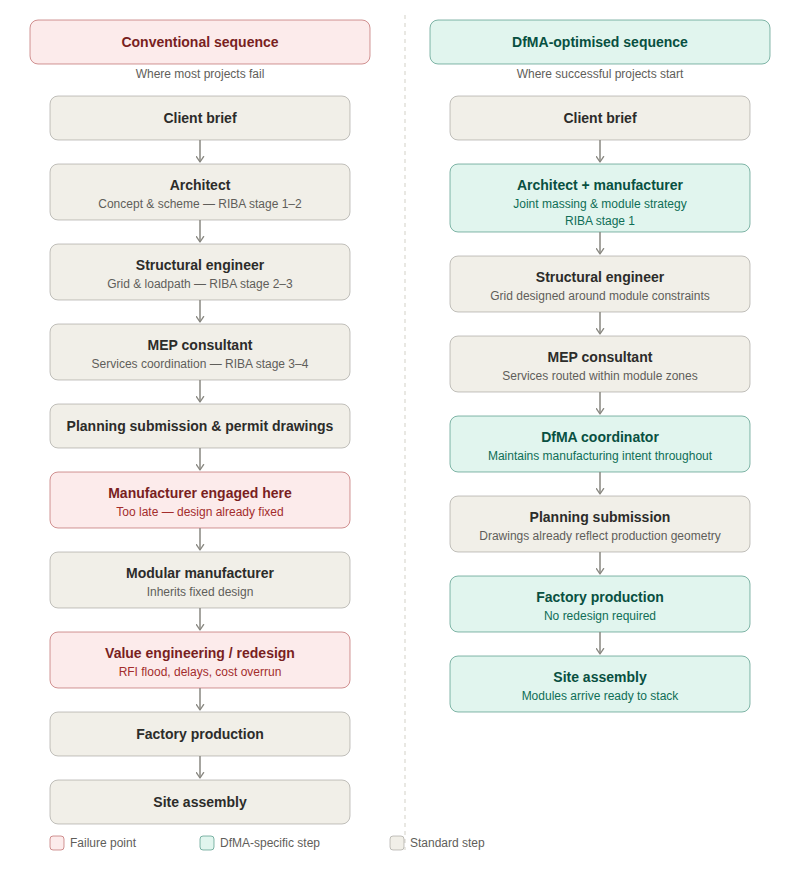
The critical dependency is simple: manufacturer input must precede structural grid lock. Once the grid is fixed, the opportunity for genuine DfMA optimization is largely closed.
Projects That Got It Right
The global project record for successful DfMA is more substantial than the industry conversation suggests. The failures are louder because they produce disputes, delays, and cost overruns that generate press coverage. The successes tend to be quieter.
Residential & Mixed Use:
- Clement Canopy, Singapore (2018) — 505-unit residential development using precast volumetric modules. Manufacturer (Dragages Singapore) engaged at schematic design. Delivered 6 months ahead of program. Considered the benchmark for high-rise modular in Southeast Asia.
- 461 Dean Street, Brooklyn (2016) — 32-story modular residential tower by Forest City Ratner / Skanska. Troubled project that is nevertheless instructive: the lessons from its difficulties directly informed subsequent successful modular projects in New York.
- Apex House, Wembley (2017) — 29-story student accommodation by Tide Construction / Vision Modular. 679 modules. Manufacturer engaged at RIBA Stage 1. Delivered on program.
- Maccreanor Lavington Social Housing, London — Multiple schemes where L&G Modular Homes engaged at massing stage. Consistent program delivery within 5% of target.
Infrastructure & Bridges — DfMA in Civil Engineering:
This is where the conversation becomes directly relevant to structural engineers, and where the evidence base is strongest.
- Hammersmith Flyover Strengthening, London — Prefabricated post-tensioning systems designed for factory production and rapid installation during weekend possessions. Classic DfMA application to existing infrastructure.
- Network Rail Modular Bridge Program, UK — Standard modular bridge designs (10m, 20m, 30m spans) developed with manufacturers to allow factory production and single-weekend installation. Reduces possession time from weeks to hours. This is probably the most mature DfMA program in civil infrastructure globally.
- Millau Viaduct, France (2004) — While not modular in the residential sense, the pylon and deck fabrication were designed explicitly around factory production sequences and site assembly tolerances. A landmark in design-for-assembly at infrastructure scale.
- Hong Kong MTR Infrastructure Extensions — Multiple station structures and viaduct sections designed for prefabrication, driven by the impossibility of extended site access in dense urban environments.
- Singapore’s Land Transport Authority Bridge Program — Standardized precast bridge components manufactured to interchangeable tolerances. Reduces design time per crossing by 40–60% once the standard library is established.
DfMA Advantages and Disadvantages
| Factor | Advantage | Disadvantage |
| Program | 20–35% schedule reduction (optimized projects) | Front-loaded design time; slower Stage 1–2 |
| Quality | Factory-controlled production environment | Defects harder to remediate once modules are assembled |
| Cost | Labor saving on site; reduced preliminaries | Higher design fees; manufacturer margin; transport costs |
| Safety | Reduced site working at height and in confined spaces | Factory safety regime must be verified separately |
| Design Flexibility | Excellent for repetitive typologies | Poor for highly bespoke or irregular geometries |
| MEP Integration | Services pre-installed in factory conditions | Requires early MEP decisions; changes are expensive |
| Sustainability | Reduced site waste; better material utilization | Embodied carbon of transport; end-of-life disassembly rarely designed in |
| Supply Chain | Predictable factory scheduling | Manufacturer capacity constraints; long lead times |
| Planning | No inherent advantage or disadvantage | Some jurisdictions have limited experience with modular typologies |
| Financing | Faster delivery improves development returns | Lenders less familiar with modular risk profile |
Which Countries Are Leading in DfMA
Singapore is the global leader by policy integration. The Building and Construction Authority (BCA) mandates Prefabricated Prefinished Volumetric Construction (PPVC) for a significant proportion of public housing. Manufacturer engagement protocols are standardized. The result is a mature supply chain and a project record that other markets are now studying.
United Kingdom has the most developed policy framework outside Singapore, driven by the Farmer Review (2016) and subsequent government commitments to Modern Methods of Construction (MMC) in public housing. The framework is ahead of actual delivery — the supply chain is still developing — but the intellectual infrastructure is strong.
Scandinavia (particularly Sweden and Norway) has a long tradition of timber volumetric construction that constitutes genuine DfMA practice, even if it predates the terminology.
Japan has a highly developed manufactured housing sector (Sekisui House, Daiwa House) but the approach is more product-led than project-led — less transferable to bespoke commercial development.
Australia is an emerging market with genuine momentum, particularly in the social housing sector following state government procurement commitments in Victoria and Queensland.
United States is fragmented — strong in specific markets (student accommodation, military housing, healthcare) but lacking the national policy framework that drives consistency.
The Honest Assessment: Where DfMA Actually Works
DfMA is not a universal solution. It is a powerful tool for a specific project profile.
It works best — and arguably only works well — on projects with a significant number of repetitive design and production processes. Residential towers above eight stories with repeating floor plates. Student accommodation. Hotels. Hospital wards. Modular bridge spans on standardized crossings. Military and education facilities with repeating room types.
It works poorly on projects where design complexity is the point. Cultural buildings. Civic landmarks. Highly serviced research facilities. Irregular sites that resist geometric repetition.
This is not a limitation that technology will fully overcome. The economics of factory production depend on amortizing setup costs across volume. A bespoke module is expensive to produce precisely because it cannot benefit from the repetition that makes factory production efficient.
The firms getting DfMA right have accepted this constraint and designed their project selection accordingly. They are not trying to make DfMA work on every project. They are identifying the projects where it is genuinely the right delivery strategy — and engaging manufacturers at RIBA Stage 1 or equivalent before massing is locked.
The result is fewer RFIs, fewer site clashes, and modules that arrive ready to stack rather than ready to argue about.
